
Now Reading: The Big Bang
-
01
The Big Bang

The Big Bang

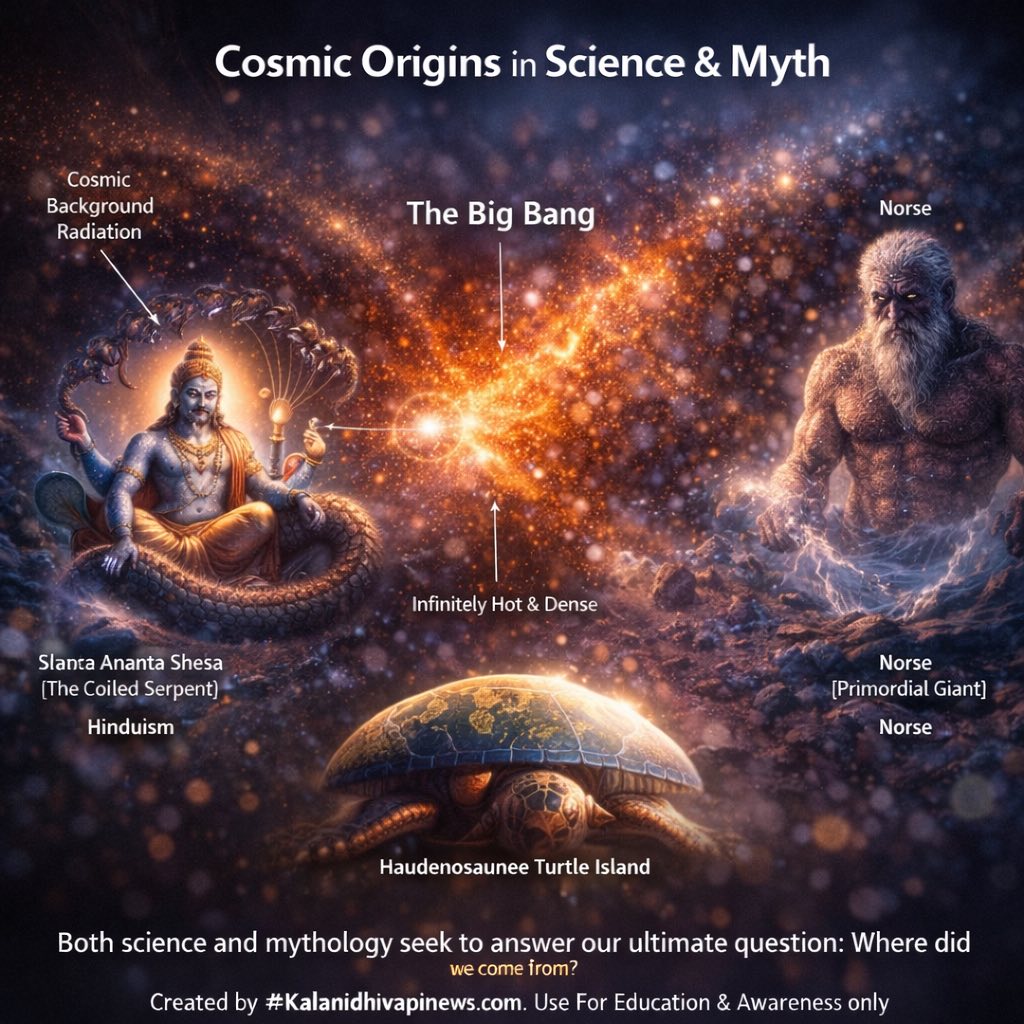
The Big Bang describes the moment when the universe began expanding from an extremely hot and dense state. It explains how space, time, matter, and energy emerged together rather than into empty space. This concept helps humanity understand that the universe has a measurable history and direction. It emphasizes that existence is rooted in a dynamic beginning rather than a static eternity.
Glossary: Big Bang – the scientific model describing the universe’s initial expansion.
created by @kalanidhivapinews.com for awareness only
⸻
A singularity represents a state where all matter and energy were compressed beyond known physical limits. At this point, conventional laws of physics cease to function as we understand them. It symbolizes the ultimate unity of space, time, and matter. This idea invites humility about the limits of human knowledge.
Glossary: Singularity – an infinitely dense point at the universe’s origin.
created by @kalanidhivapinews.com for awareness only
⸻
Inflation refers to the extremely rapid expansion that occurred fractions of a second after the beginning. This process explains why the universe appears uniform in all directions. It shows how small quantum fluctuations shaped large cosmic structures. Inflation highlights how tiny beginnings can create vast outcomes.
Glossary: Inflation – rapid early expansion of the universe.
created by @kalanidhivapinews.com for awareness only
⸻
Cosmic expansion describes how space itself continues to stretch over time. Galaxies move apart not because of motion through space, but because space grows between them. This reinforces that the universe is dynamic and evolving. It also places humanity within an ongoing cosmic process.
Glossary: Expansion – the increasing scale of space over time.
created by @kalanidhivapinews.com for awareness only
⸻
Matter consists of the physical substance that forms stars, planets, and life. Nearly all matter formed within the universe’s first few minutes. Its stability depends on precise physical conditions. Matter reflects the balance required for existence itself.
Glossary: Matter – substance composed of particles with mass.
created by @kalanidhivapinews.com for awareness only
⸻
The cosmos refers to the universe viewed as an ordered and interconnected whole. It emphasizes structure rather than chaos. Understanding the cosmos encourages respect for natural laws. It also links scientific discovery with philosophical reflection.
Glossary: Cosmos – the universe as an ordered system.
created by @kalanidhivapinews.com for awareness only
⸻
The universe includes all space, time, matter, and energy. Its laws govern everything from particles to galaxies. Studying the universe reveals consistent patterns behind apparent randomness. This awareness fosters a sense of shared cosmic belonging.
Glossary: Universe – the totality of all existence.
created by @kalanidhivapinews.com for awareness only
⸻
Cosmic background radiation is the lingering heat from the early universe. It serves as measurable evidence of the universe’s hot origin. This faint signal fills all of space uniformly. It acts as a historical record of creation.
Glossary: Radiation – energy emitted as waves or particles.
created by @kalanidhivapinews.com for awareness only
⸻
Scientific evidence connects theory with observation. Background radiation transformed abstract ideas into testable reality. Evidence strengthens trust in systematic inquiry. It shows that truth can be discovered through careful measurement.
Glossary: Evidence – observable data supporting explanations.
created by @kalanidhivapinews.com for awareness only
⸻
Fine-tuning describes how physical constants fall within narrow life-permitting ranges. Small changes would prevent stars, atoms, or chemistry from forming. This precision provokes deep reflection about existence. It bridges science with existential curiosity.
Glossary: Fine-tuning – precise balance of physical constants.
created by @kalanidhivapinews.com for awareness only
⸻
Gravity shapes galaxies, stars, and planetary systems. Its strength allows matter to clump without collapsing instantly. Gravity gives structure to the universe. It also governs the rhythm of cosmic evolution.
Glossary: Gravity – force attracting masses to one another.
created by @kalanidhivapinews.com for awareness only
⸻
Electromagnetism binds electrons to nuclei, enabling atoms and chemistry. It allows light, electricity, and biological processes. Without it, complexity would not arise. This force underpins everyday existence.
Glossary: Electromagnetism – force governing electric and magnetic interactions.
created by @kalanidhivapinews.com for awareness only
⸻
The strong nuclear force binds protons and neutrons inside atomic nuclei. It overcomes repulsion between positively charged particles. This force makes stable matter possible. Its precision is essential for life.
Glossary: Strong force – fundamental force holding nuclei together.
created by @kalanidhivapinews.com for awareness only
⸻
Quarks are fundamental building blocks of protons and neutrons. They never exist freely but always in combinations. Their interactions define nuclear stability. Quarks reveal nature’s hidden complexity.
Glossary: Quark – elementary particle forming hadrons.
created by @kalanidhivapinews.com for awareness only
⸻
Protons carry positive charge within atomic nuclei. Their number defines each chemical element. Protons enable atomic diversity. They are essential to matter’s identity.
Glossary: Proton – positively charged subatomic particle.
created by @kalanidhivapinews.com for awareness only
⸻
Neutrons stabilize atomic nuclei by offsetting proton repulsion. They allow heavier elements to exist. Their balance influences radioactive decay. Neutrons shape material diversity.
Glossary: Neutron – neutral subatomic particle in nuclei.
created by @kalanidhivapinews.com for awareness only
⸻
Hydrogen is the simplest and most abundant element. It fueled the first stars and cosmic structures. Hydrogen powers stellar fusion. It marks the universe’s earliest chemistry.
Glossary: Hydrogen – lightest chemical element.
created by @kalanidhivapinews.com for awareness only
⸻
Helium formed shortly after hydrogen in the early universe. It contributes to stellar evolution and stability. Its abundance confirms early cosmic processes. Helium reflects primordial synthesis.
Glossary: Helium – second lightest chemical element.
created by @kalanidhivapinews.com for awareness only
⸻
Time began with the universe itself. It flows forward alongside cosmic expansion. Time links cause and effect. Understanding time reshapes perspective on existence.
Glossary: Time – dimension of sequential change.
created by @kalanidhivapinews.com for awareness only
⸻
Space is the framework in which matter exists and moves. It expands along with the universe. Space is dynamic rather than empty. It connects all cosmic events.
Glossary: Space – the dimensional expanse containing matter.
created by @kalanidhivapinews.com for awareness only
⸻
Discovery transforms curiosity into knowledge. Observations of background radiation confirmed cosmic origins. Discovery relies on patience and rigor. It advances collective understanding.
Glossary: Discovery – finding new knowledge through observation.
created by @kalanidhivapinews.com for awareness only
⸻
Existence reflects the fact that something is present rather than nothing. It depends on precise cosmic conditions. Human existence is deeply contingent. This inspires gratitude and reflection.
Glossary: Existence – state of being real.
created by @kalanidhivapinews.com for awareness only
⸻
Consciousness allows the universe to be observed and understood. It emerges from complex biological organization. Conscious beings reflect on cosmic origins. Awareness connects science with meaning.
Glossary: Consciousness – awareness of self and surroundings.
created by @kalanidhivapinews.com for awareness only
⸻
Spirituality seeks meaning beyond physical explanation. It complements scientific understanding with inner reflection. Cosmic origins inspire spiritual inquiry. It emphasizes interconnectedness.
Glossary: Spirituality – pursuit of meaning and transcendence.
created by @kalanidhivapinews.com for awareness only
⸻
Mythology preserves symbolic explanations of origins. It reflects human attempts to understand creation. Myths encode cultural wisdom. They coexist with scientific narratives.
Glossary: Mythology – traditional symbolic stories.
created by @kalanidhivapinews.com for awareness only
⸻
Vishnu symbolizes cosmic preservation and balance. His imagery reflects cyclical creation concepts. Myth expresses universal order. It parallels ideas of cosmic stability.
Glossary: Vishnu – preserver deity in Hindu tradition.
created by @kalanidhivapinews.com for awareness only
⸻
Ananta represents infinite continuity. The serpent symbolizes timelessness. This imagery echoes cosmic eternity. Myth and cosmology intersect symbolically.
Glossary: Ananta – endless cosmic serpent.
created by @kalanidhivapinews.com for awareness only
⸻
Ymir represents primordial chaos in Norse tradition. Creation arises from transformation. Myth mirrors cosmic beginnings. Symbolism conveys origin themes.
Glossary: Ymir – primordial giant in Norse mythology.
created by @kalanidhivapinews.com for awareness only
⸻
Turtle Island symbolizes Earth’s foundation in Indigenous lore. It emphasizes harmony with nature. Creation stories stress balance. Myth reinforces environmental respect.
Glossary: Turtle Island – Earth in Haudenosaunee tradition.
created by @kalanidhivapinews.com for awareness only